Heartburn (GERD): Understanding Gastroesophageal Reflux Disease and Its Mechanisms

Heartburn, often associated with gastroesophageal reflux disease (GERD), is caused by the abnormal backflow of stomach contents into the esophagus and sometimes into the upper airways.

It’s not just heartburn.
GERD can also cause:

  • a sore throat

  • chronic cough

  • hoarseness

  • a constant sensation of mucus

  • pharyngeal discomfort (globus sensation)

Understanding its pathophysiology allows for more targeted treatment.

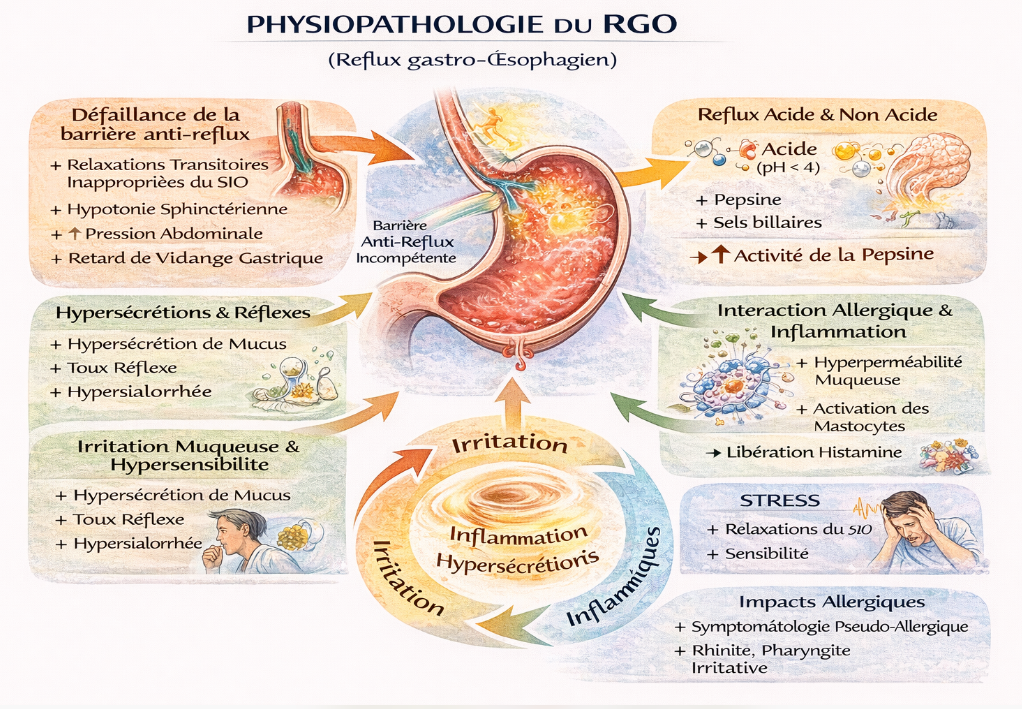
1. Why does reflux occur?

Reflux occurs primarily due to a dysfunction of the lower esophageal sphincter (LES).

This sphincter acts as a valve between the stomach and the esophagus.
When it becomes incompetent, several mechanisms promote acid reflux:

  • Inappropriate transient relaxations

  • Sphincter hypotonia

  • Excessive abdominal pressure

  • Delayed gastric emptying

Gastric contents (acid, pepsin, and sometimes bile) then flow back up into the esophagus.

2. Acid reflux… but not only that

We distinguish between:

  • Acid reflux (pH

  • Weakly acidic or non-acidic reflux

Even without significant acidity, pepsin remains biologically active and can irritate the ENT mucous membranes.

👉 This is why some patients continue to experience symptoms despite antacid treatments.

3. Mucosal irritation and hypersensitivity

Repeated exposure to reflux leads to:

  • Impaired epithelial barrier

  • Increased permeability

  • Visceral hypersensitivity

Even small amounts of reflux can then cause:

  • Heartburn

  • Persistent dry cough

  • Hoarseness

  • A sensation of a blocked throat


We often refer to laryngopharyngeal reflux when the symptoms are primarily ENT-related.

4. Chronic inflammation and mucus production

Repeated irritation triggers an inflammatory response:

  • Activation of pro-inflammatory cytokines

  • Local edema

  • Redness and irritation

In response, the body produces more mucus to protect itself.
➡️ This mucus can sometimes become excessive and leads to:

  • Throat clearing

  • A feeling of congestion

  • Reflex cough

This inflammatory cycle explains why symptoms become chronic.

5. GERD, allergies, and stress: a common interaction

GERD does not occur in isolation.

It interacts with:

  • Allergic predisposition

  • Chronic airway inflammation

  • Stress and autonomic nervous system regulation

Stress increases relaxation of the esophageal sphincter and heightens symptom perception.

Allergies can increase mucosal permeability and exacerbate local inflammation.

It is therefore a complex functional and inflammatory disorder.

🔸 Can we treat the symptoms of hemorrhoids?

Management focuses on several areas:

  • Lifestyle and dietary measures

  • Stress management

  • Supporting the mucosal barrier

  • Relief of local inflammation

  • Regulation of hypersecretion

As part of this comprehensive approach, certain natural solutions can help support the comfort of the digestive and ENT mucous membranes.

Specific formulas, such as Mucodistim, have been developed to support mucosal balance and help reduce discomfort associated with chronic irritation linked to reflux, particularly when symptoms are dominated by secretions and pharyngeal irritation.

They are part of a complementary strategy and are not intended to replace medical care when it is necessary.

👉 In summary

Gastroesophageal reflux disease (GERD) is a multifactorial condition involving:

  • Dysfunction of the lower esophageal sphincter

  • Acid or non-acid reflux

  • Mucosal irritation and hypersensitivity

  • Chronic inflammation

  • Excessive mucus secretion

  • Interaction with stress and allergic predisposition

This is not merely a problem of acidity.
It is an inflammatory and functional imbalance that requires a holistic approach.

Product added to wishlist
Product added to compare.